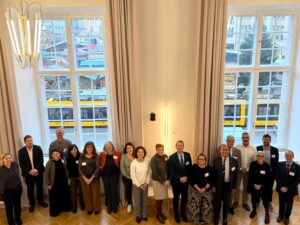
CLUSTER universities gathered at TU Darmstadt to advance joint projects, explore innovation cooperation and strengthen international partnerships.
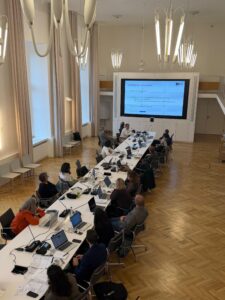
Technische Universität Darmstadt hosted two days of CLUSTER Steering Committee and Working Group meetings on 12–13 November, bringing member universities together to develop joint initiatives in education, research and innovation. Politecnico di Torino played a central role, with Rector Stefano Corgnati, CLUSTER President, chairing the Steering Committee and Professor Roberto Zanino, CLUSTER Secretary General, leading the Strategic Projects Workshop.
“Over these two days in Darmstadt, we have been discussing the future of European universities of science and technology. Technology is becoming increasingly important, while European networks and alliances are playing a crucial role in expanding our research networks and infrastructure, and in enabling our young researchers to access an increasingly broad range of opportunities”, stated Stefano Corgnati, CLUSTER President and Politecnico di Torino’s Rector.
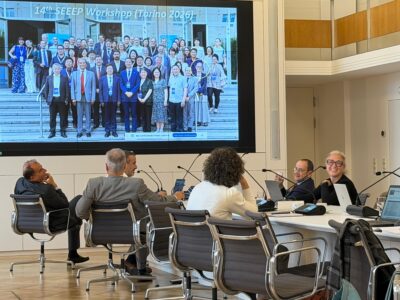
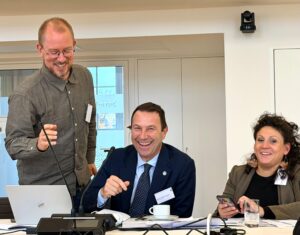 The Strategic Projects Workshop on the morning of 12 November explored proposals from CLUSTER’s three Vertical Working Groups. The Sub-Saharan Africa group presented the CLUSTER–Africa Co-Design Accelerator, an initiative to develop joint projects with African partners around shared priorities. The European Universities Initiatives group proposed cooperation on artificial intelligence in education, drawing on expertise across the CLUSTER universities providing ideas and good practices to Alliances to strengthen AI literacy and promote responsible use. The Sino-EU Engineering Education Platform (SEEEP) group outlined a proposal to support research and advanced training cooperation, including travel grants for early-career researchers.
“CLUSTER is focusing on strategic projects that we hope will bring concrete added value to the internationalization of our Universities in their European University Alliances, in sub-Saharan Africa and in China, particularly emphasizing the role that Science &Technology Universities can play in the different arenas”, added Roberto Zanino.
The afternoon’s Steering Committee meeting took forward the strategic priorities discussed by CLUSTER Presidents and Rectors on 2 October.
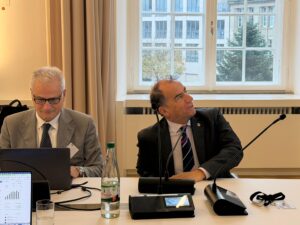
A key development arising from that meeting was the proposal to establish a Working Group on Innovation. Professor Tim Bedford, from the University of Strathclyde, presented the proposed group’s approach: sharing experience in entrepreneurship, research commercialization and university–industry partnerships, and connecting the complementary strengths of member universities to develop joint initiatives.
The programme included a dedicated workshop on grade conversion, focusing on a shared tool to make the conversion of academic results between partner universities more efficient and consistent, supporting student mobility across the network.
International cooperation also featured on the agenda, with discussions on preparations for the 15th SEEEP Workshop, to be hosted by Tongji University in Shanghai in May 2027. The event will provide an opportunity to further develop scientific cooperation and exchanges with Chinese partner universities. Eindhoven University of Technology (TU/e) also presented plans for the next CLUSTER General Assembly and related meetings, scheduled for 16–17 June 2027.